ADT Burglar Alarm Alternatives: What You Get, and Four Systems Without a Contract
Affiliate Disclosure: This article contains affiliate links. If you buy through these links, we may earn a commission at no extra cost to you. Our editorial opinions are our own and are not influenced by affiliate relationships. Read our full disclosure policy →
Contents
Quick Answer
ADT’s traditional burglar alarm is professionally installed and contract-backed, and for some households that is exactly right. But if what you want is ADT’s monitoring without the multi-year agreement, ADT now sells a DIY line of its own — and if you want neither, three self-install systems do the same job with no contract at all. For what each route actually costs once equipment, installation and monitoring are added up, see our home security system cost breakdown.
What an ADT burglar alarm actually is
The traditional ADT product is a professionally installed alarm with monitored dispatch. Professional installation is not optional — Security.org notes ADT’s Pro Install line requires it on every system. The monitoring agreement is where most of the commitment sits: ADT’s standard residential contract runs 36 months, or 24 in California. One nuance the marketing rarely leads with is that the contract is tied to how you pay for the hardware rather than to the alarm itself — buy the equipment outright and a monitoring contract is not required, but finance it and you sign for the length of the financing term. Our full ADT review works through the tiers.
The real trade-off
What you get
- Professional installation
- Staffed monitoring and dispatch
- One accountable company
- Equipment maintained for you
What you accept
- A multi-year agreement
- Early-termination costs
- Equipment tied to the service
- Less freedom to change your mind
ADT’s own DIY alternative
ADT Blu Home Safety Essentials Kit — ADT without the contract
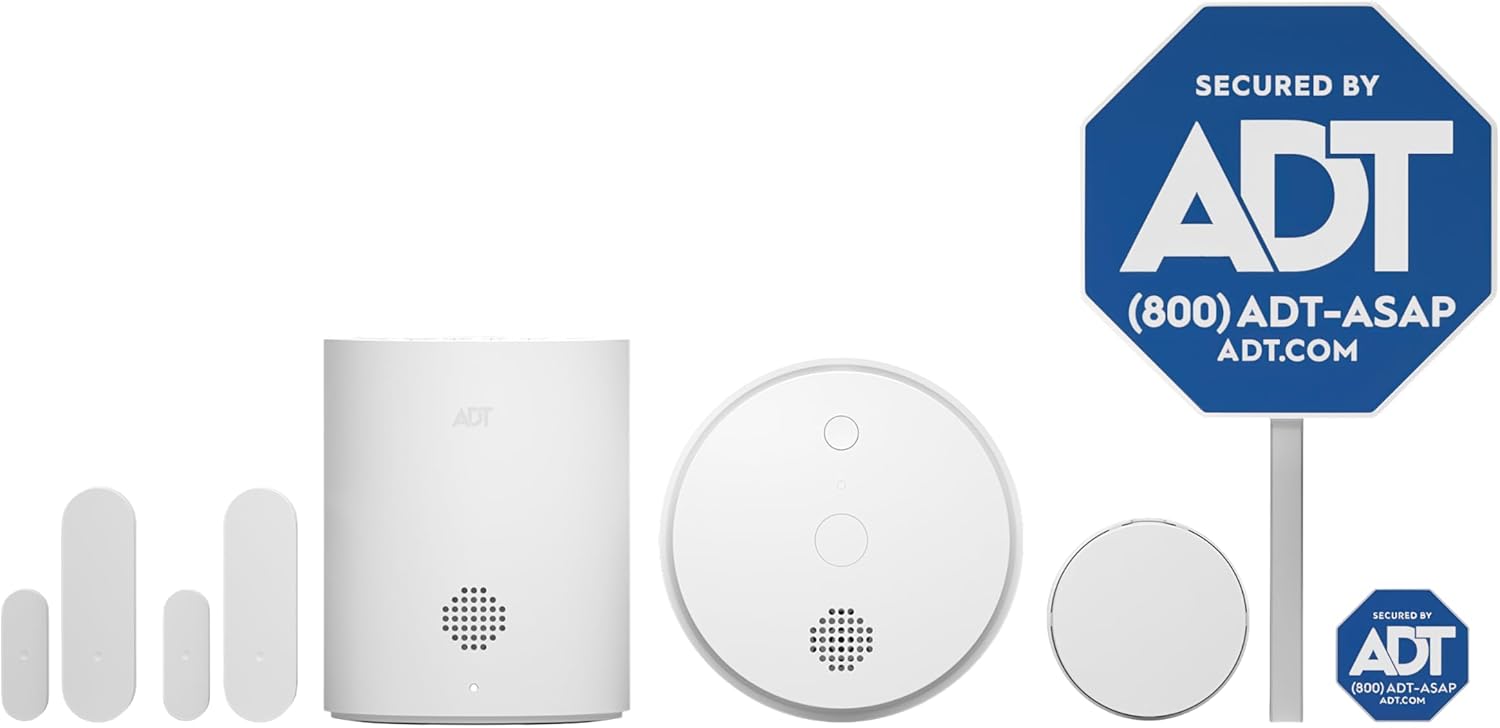
Key specs: DIY kit · smoke + CO detector · water leak sensor · ADT+ app
If the appeal is the ADT name and its monitoring rather than the engineer visit, this is the same brand in self-install form. Be precise about what changes, though: this kit still needs a plan. What it does not need is a contract. Security.org’s testers report that none of ADT Blu’s plans carry one, and that they switched tiers twice mid-test without a cancellation fee either time — and one of those tiers is self-monitoring rather than professional monitoring.
✅ Pros
- ADT monitoring with no long-term contract on any plan
- Includes smoke, CO and water-leak sensors
- Self-install — no engineer visit to schedule
- Managed through ADT’s own app
❌ Cons
- A newer product with a small review base so far
- You handle installation and any later moves
- A plan is still required — the kit is not usable plan-free
- Fewer sensor types than a full professional fit-out
Three systems with no contract at all
SimpliSafe 8-Piece Wireless System — Best all-round alternative
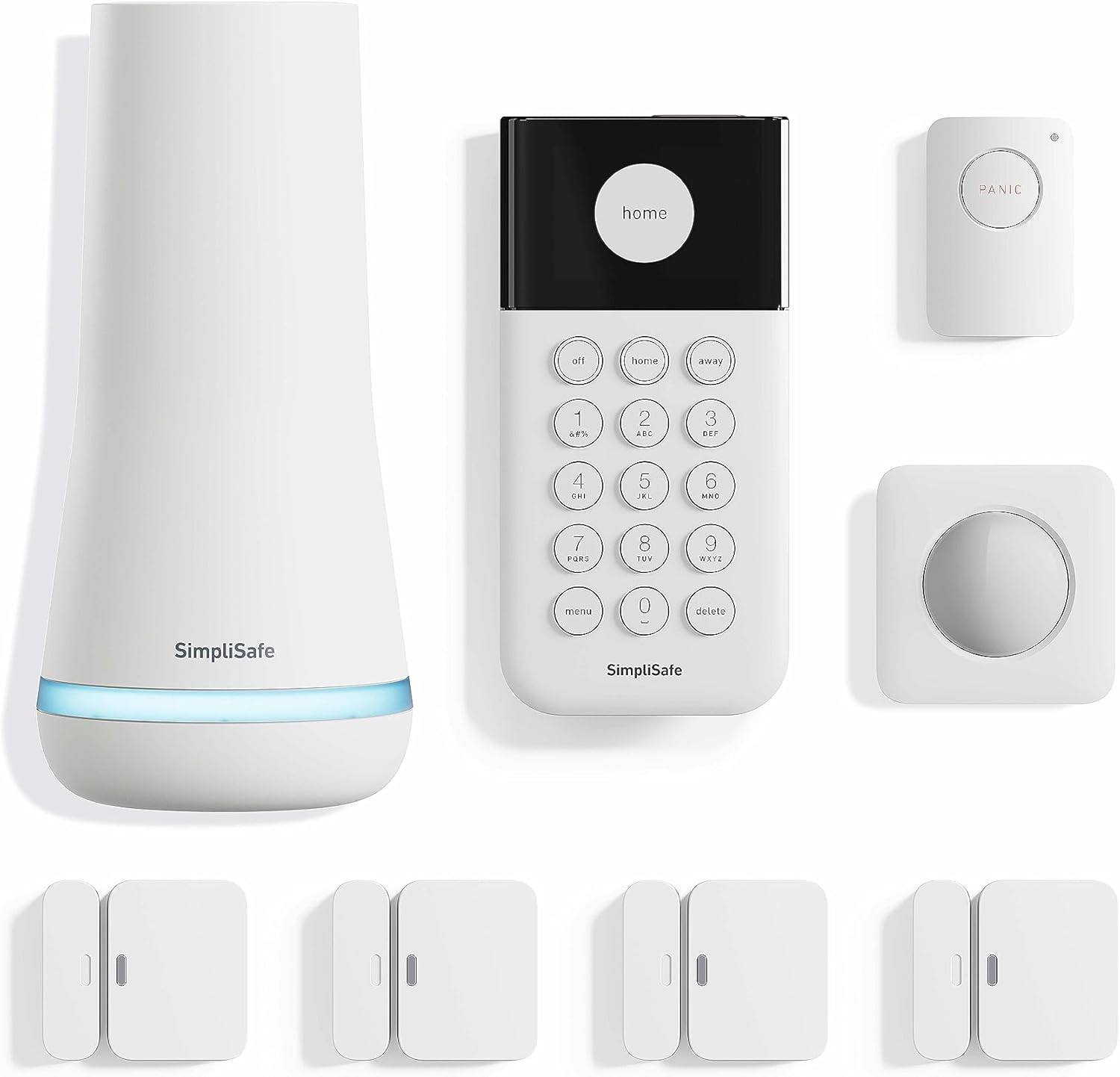
Key specs: 8 pieces · no contract · optional monitoring · Alexa and Google Assistant
The most established DIY alternative to a monitored alarm, and the one most people weigh ADT against. Monitoring is optional rather than a multi-year commitment: SafeHome.org’s review puts it plainly, that whether you self-monitor or move up to professional monitoring, SimpliSafe gives you that flexibility without commitments.
✅ Pros
- No contract at any tier
- Monitoring switches on and off monthly
- Large, long-established review base
- Works with Alexa and Google Assistant
❌ Cons
- You install and maintain it yourself
- Self-monitoring means no dispatch unless you pay
- Keypad design is dated next to newer rivals
Ring Alarm 14-Piece Kit — Best if you already own Ring cameras

Key specs: 14 pieces · expandable · optional professional monitoring · Alexa built in
If there are already Ring doorbells or cameras on the house, this puts the alarm in the same app rather than adding a second one. That single-app argument is the strongest reason to pick it. Worth knowing before you buy: Ring states that with no subscription the siren still sounds, but you and any shared users do not receive digital notifications — so the free tier is a local alarm rather than a remote one.
✅ Pros
- One app for alarm, doorbell and cameras
- Expandable a sensor at a time
- Monitoring is optional, and self-monitoring needs no plan
- Alexa built into the base station
❌ Cons
- The ecosystem pull only helps if you are already invested
- Cloud recording for the cameras still costs monthly
- Fourteen pieces is more than a small home needs
Arlo Home Security System — Best coverage per sensor

Key specs: wired keypad hub · 5 eight-in-one sensors · no contract · DIY install
Arlo’s all-in-one sensors are genuinely eight devices in one shell. Arlo’s own documentation names the functions: motion, open/close by magnet, open/close by tilt, water leak, temperature, light, smoke alarm listening and CO alarm listening. Not all eight run at once — water leak and open/close cannot share a sensor, for instance — but fewer units still cover more conditions than a conventional door-contact system.
✅ Pros
- Each sensor handles several detection types
- No contract required
- Wired keypad hub is harder to disable than a battery unit
- Straightforward DIY install
❌ Cons
- Smaller review base than SimpliSafe or Ring
- Good value only if you use the multi-sensor features
- Arlo’s camera line pushes its own subscription
Side by side
What ADT’s own record actually shows
Brand comparisons in this category trade mostly in impressions. Two public records are harder to argue with, and both are worth reading before you sign anything.
The first is the agreement. ADT’s standard residential contract runs 36 months, or 24 in California, and cancelling early is charged at 75 percent of what remains on the term, due in full on the termination date. If you move, ADT will generally cancel the existing agreement without that fee and start a fresh one at the new address — but the equipment stays behind at the old one. That last detail catches people out more often than the fee does.
The second is the complaint record. ADT holds an A rating from the Better Business Bureau while also carrying more than 10,000 complaints closed through the BBB in the past three years. Both are true at once and neither cancels the other: a company that size generates volume, and a BBB rating reflects how a business responds to complaints rather than how few it receives. What it does mean is that the terms above deserve reading properly rather than taking on trust.
None of this is an argument against ADT. It is an argument for being clear which of its two products you are actually buying — the professionally installed one with the agreement attached, or the self-install line, where Security.org’s testers found no contract on any plan and no penalty for switching tiers mid-subscription.
Questions to ask before you sign anything
If you do go with a professionally installed, contract-backed system — from ADT or anyone else — these are the questions that decide whether you are happy in year three. Ask them before signing, not after.
- How long is the agreement, exactly? Not the marketing number — the number in the contract you are signing.
- What does it cost to leave early? Ask for the figure in writing. ADT’s published terms charge 75 percent of the remaining balance, due in full on the termination date.
- Do I own the equipment or lease it? This decides what happens if you cancel, and whether anything is yours to take.
- What happens if I move? Some agreements transfer, some restart, some charge for relocation.
- Is monitoring included at this price, or is it a promotional rate? Introductory pricing that steps up later is normal and worth pricing in.
- Will they dispatch on an alarm alone? Usually yes — verified response, where the monitoring company must confirm a break-in before police are called, is still the exception rather than the rule. But it exists, cuts alarm call volume by roughly 90 percent where it is adopted, and is worth checking locally rather than assuming.
How to choose between these four
Strip away the branding and there are really only three questions that separate them. None of them is about which logo is on the keypad, and all three are worth answering before you look at a single price.
Do you want anyone else involved? If you want a company accountable for the system, ADT’s professional product is the one built for that. If you would rather own it outright, any of the other three.
What do you already own? If there are Ring cameras on the house already, the Ring alarm removes a second app for no extra cost. If not, that advantage disappears and the comparison is on merit alone.
How many devices do you want on the wall? Arlo’s multi-function sensors cover more conditions per unit; SimpliSafe and Ring use more, simpler devices. Neither is better — it is a preference about how much hardware you want visible.
If you want the wider field rather than just ADT’s alternatives, our DIY alarm systems guide covers it, and this three-way comparison puts the big monitored brands side by side.
Final Recommendation
For most people leaving ADT, the SimpliSafe 8-Piece Wireless System is the one to start with. It is the closest like-for-like replacement for what a traditional monitored system actually does day to day, it installs in an afternoon, and monitoring stays optional rather than contractual. If you want one answer, that is it.
Choose the ADT Blu Home Safety Essentials Kit instead if the thing you actually valued about ADT was ADT — the brand, the accountability, a company to call when something goes wrong. It gives you their monitoring without the multi-year agreement, which is the specific trade most people in this situation are looking for.
Two situations change the answer outright. If there are already Ring cameras on the house, the Ring Alarm 14-Piece Kit removes a second app for no extra money, and that convenience outweighs any spec difference here. If you would rather have fewer devices on the wall each doing more, the Arlo Home Security System covers more conditions per sensor.
What should not decide it is the logo on the keypad. All four sound a siren locally without paying anyone a monthly fee.
Frequently Asked Questions
Can I get ADT monitoring without the long contract?
Yes, with one clarification. ADT Blu still requires a plan, but none of its plans is a long-term contract, and one of the tiers is self-monitoring rather than professional monitoring.
Is a monitored alarm actually better at getting police out?
Not automatically. Many US cities now require verified evidence before dispatch. We covered this in verified response.
What happens to ADT equipment if I cancel?
On the traditional professionally installed product the equipment is tied to the service agreement. Read the specific contract rather than assuming you keep it.
How do ADT, SimpliSafe and Vivint compare directly?
We put the three head to head in this comparison.
Is ADT’s DIY line the same monitoring as the professional product?
It is ADT’s monitoring, without the multi-year agreement the traditional product requires. Check the specific plan for what is included.
Can I self-monitor and add professional monitoring later?
On SimpliSafe, Ring and Arlo, yes. That flexibility is the main practical difference from a traditional contract.
Do any of these work without internet?
The sirens do — sensors talk to the hub on their own radio. What you lose is app alerts and, where applicable, monitoring.
Which has the best track record?
On the DIY side, SimpliSafe’s no-commitment structure is long established and independently reviewed, and Ring publishes exactly what self-monitoring does and does not include. On the professional side the fairest public record is ADT’s Better Business Bureau profile, which is worth reading in full rather than summarised.
Sources
Show sources (8)
SafeBode does not yet run an in-house product testing program. This guide is built from manufacturer specifications, current retail listings and verified buyer feedback rather than hands-on testing, and we say so plainly rather than implying testing we have not done.


