Best Safes for Storing Cash at Home 2026
Affiliate Disclosure: This article contains affiliate links. If you buy through these links, we may earn a commission at no extra cost to you. Our editorial opinions are our own and are not influenced by affiliate relationships. Read our full disclosure policy →
Contents
Quick Answer
Most “best safe” guides treat cash like any other valuable. It isn’t. A standard homeowners policy caps money, coins, and medals at a flat 200-dollar limit per loss, regardless of how good the safe is — while jewelry, furs, silverware, and firearms are capped far higher, around 2,500 dollars, and can usually be scheduled onto a rider for their full appraised value. A safe protects cash from theft. It does nothing about being underinsured for it. Once that’s clear, the safe you actually want depends on how you use the cash: a keypad or biometric safe for money you access often (a household reserve, a small-business float), and a slower, fire-rated safe for a true emergency stash you rarely touch.
The Insurance Problem Almost No Buying Guide Mentions
Search for “best safe for cash” and almost every result focuses entirely on the safe: steel gauge, fire rating, lock type. Almost none of them mention that your homeowners policy has already decided how much of that cash it will actually pay you back for, and the number has nothing to do with which safe you buy.
Policygenius, which publishes the standard sublimit table most insurers build their Coverage C personal-property section from, lists it plainly: money, including coins and medals, is capped at 200 dollars per loss. Compare that to the same table’s limits for other valuables in the same policy — jewelry, furs, silverware, and firearms are each capped around 2,500 dollars when stolen. SafeWise reports the same 200-dollar figure independently and puts it bluntly: cash usually falls into the same restricted category as coins and small valuables, so “you probably won’t recover much” unless you take a separate step.
What a Standard Homeowners Policy Actually Pays for Stolen Property
200
Dollar cap per loss on money, coins, and medals, per Coverage C’s special limits of liability
2,500
Dollar cap per loss on jewelry, furs, silverware, or firearms when stolen — the same policy, a different category
Both figures come from Policygenius’s published Coverage C sublimit table, cross-checked against SafeWise’s independent cash figure. Your specific insurer’s numbers may differ; call and ask before assuming either applies to your policy.
The gap is not a rounding error. It exists because insurers treat cash differently from every other valuable on that list. Jewelry, art, and firearms can be individually described, appraised, and “scheduled” onto a separate rider for something close to their full value. NerdWallet’s own description of how scheduled personal property coverage works is explicit about what it is for: insuring “a valuable item such as an heirloom necklace or piece of fine art” — a specific, identifiable, individually appraisable thing. A pile of currency isn’t that. There is no serial number to schedule, no appraisal to attach to a rider, so the standard sublimit is frequently the number you are actually working with, endorsement or not.
The Insurance Information Institute, the industry’s own research arm rather than a company selling anything, doesn’t publish a specific dollar figure, but it confirms the mechanism: every standard policy has a Section I, Personal Property, Special Limits of Liability section, and III’s own advice is to check those limits before assuming a purchase is covered, then buy a floater or endorsement if the limit is genuinely too low for what you’re insuring. That advice is sound for jewelry. For cash, it mostly tells you where to look, not how to fix it — which is the honest reason this article leads with insurance instead of steel gauge.
None of this means a safe is pointless. It means the safe’s job is narrower than people assume: it protects cash from being stolen in the first place, and from fire and water damage if you pick the right one. It does not, and cannot, fix the fact that your policy caps what it pays out if theft happens anyway. If you’re weighing a safe against other layers of protection, our home security system cost breakdown covers what a monitored system adds on top of a safe, and our piece on whether a monitored alarm actually gets police to show up is worth reading before you assume monitoring alone solves the theft risk a safe is meant to address.
What You’re Actually Buying: Speed, Not Just a Lock
Every safe in this guide keeps cash away from an opportunistic thief. The real difference between them is how fast you can get to your own money, and that turns out to matter more for cash than for almost anything else you’d put in a safe. A passport gets pulled out twice a year. A household cash reserve, a small-business till, or rent-collection cash gets opened constantly — sometimes daily — and a safe you find annoying to open is a safe that eventually gets left unlocked, or replaced with an unlocked drawer.
That is the organizing question behind every pick below: not “which safe is most secure in a vacuum,” but “secure for what kind of access.” A safe you open once a year to add to an emergency stash can prioritize fire protection over speed. A safe you open every shift to drop or pull cash needs to open in under two seconds or it will not get used correctly. Treating those as the same shopping decision is how people end up with a fireproof document box being used as a daily cash drawer, or a fast biometric box being asked to survive a house fire it was never rated for.
Amazon Basics Steel Security Safe with Electronic Keypad — the everyday quick-access pick
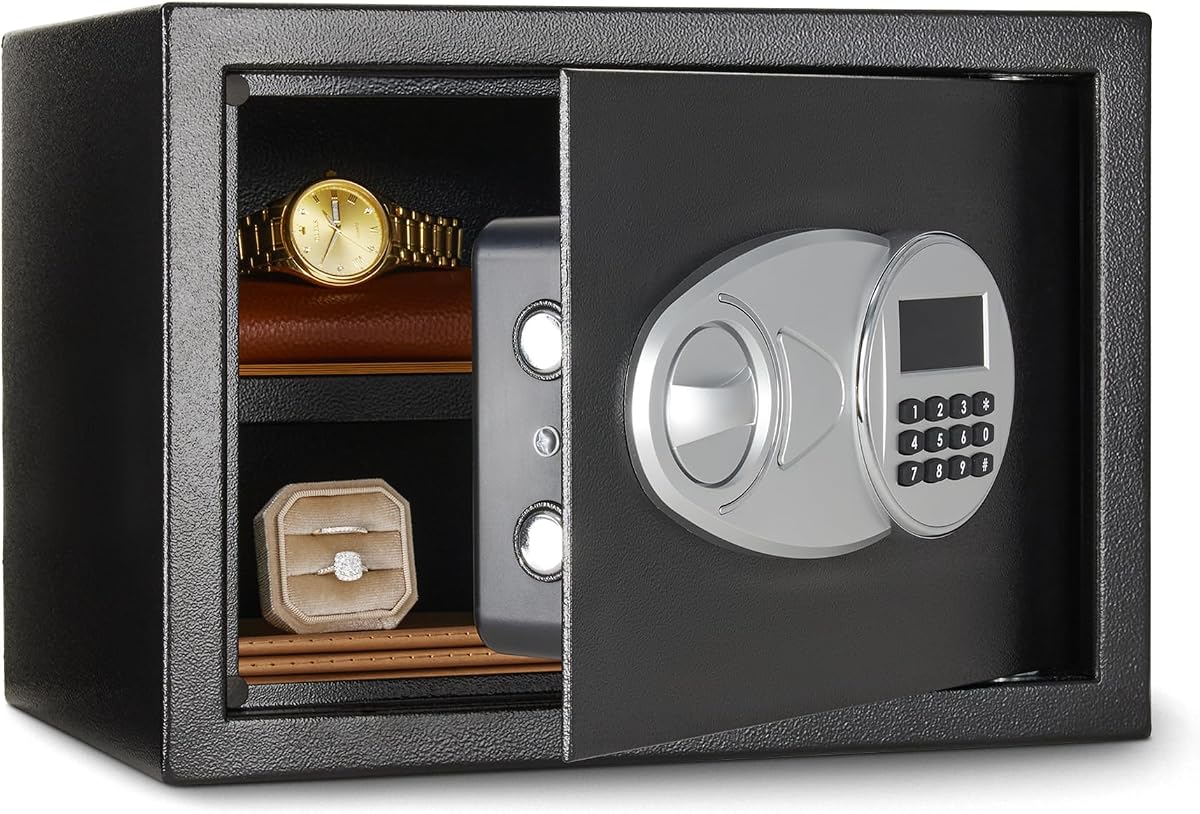
Key specs: 0.5 cu ft alloy-steel safe with an electronic keypad and 2 emergency override keys; 2 live door bolts and pry-resistant concealed hinges; pre-drilled mounting holes with 4 expansion bolts included for wall, floor, or shelf mounting; adjustable interior shelf; door roughly 2 inches thick
This is the safe for a household cash reserve or any money you expect to touch regularly: an electronic keypad you can program yourself, two live steel door bolts, and — the detail that matters far more than its price suggests — pre-drilled mounting holes with the anchor bolts already in the box. SafeWise’s own buying guide calls anchoring “the single most important thing you can do with a security safe,” since an unanchored safe can simply be carried out of the house regardless of how good its lock is. This one ships ready to be bolted to a wall stud, a shelf, or a concrete floor, not sold as an accessory. It won’t win on capacity or design, but for the price of a nice dinner it solves the two problems that actually matter for everyday cash: someone opening it who shouldn’t, and someone walking off with the whole box.
✅ Pros
- Anchor bolts included in the box, not a separate purchase — matches SafeWise’s top security recommendation for any safe in this category
- Electronic keypad is genuinely quick, and you set your own code rather than relying on a factory default
- Two emergency override keys mean a dead battery or a forgotten code doesn’t lock you out permanently
- Adjustable interior shelf keeps cash separated from documents or small electronics
❌ Cons
- No biometric option — every user needs to know the code, which is a real tradeoff if several people share access
- 0.5 cu ft is genuinely small; a business float with a cash tray will outgrow it fast
- Not fire-rated — this is a theft-and-access safe, not a fire safe, and it does not claim to be
- The included anchor hardware is sized for drywall and shelving, not poured concrete; a stud finder and the right masonry bolts matter if you’re mounting to a slab
Grimtron 20LB Biometric Safe with Fingerprint Lock — the fastest access for one household
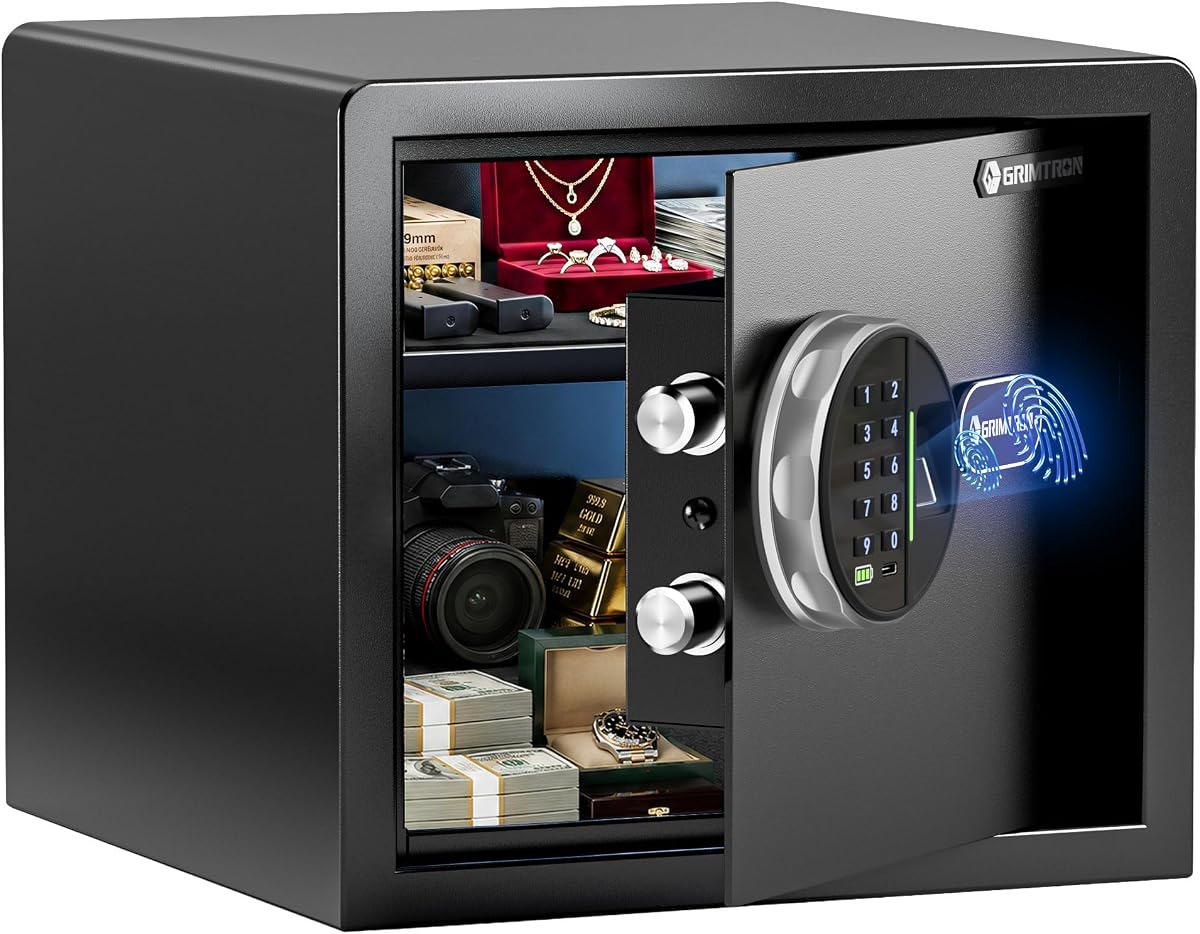
Key specs: 0.8 cu ft metal safe; fingerprint reader stores up to 30 prints with roughly a 0.3-0.5 second response; backlit 3-8 digit PIN keypad; 2 emergency override keys plus a USB emergency-power port if the batteries die; pre-drilled mounting holes
If the keypad above is fast, this is faster. A fingerprint reader that stores up to 30 prints means everyone in the household who needs access can enroll individually, and recognition lands in under a second rather than the several seconds a PIN takes to type. The backlit keypad is still there as a fallback, and a USB emergency-power port is a genuinely useful detail: if the internal batteries die and both emergency keys are missing, you can power the lock from a phone charger rather than being locked out of your own safe. At 20 lbs it’s light enough that anchoring isn’t optional — see the section below — but that is true of nearly every safe at this size and price point, not a flaw specific to this one.
✅ Pros
- Fingerprint access is the fastest of the three lock types covered here, useful for cash you reach for constantly
- Stores up to 30 fingerprints, so a shared household or small team doesn’t need a single shared code
- USB emergency-power port is a real backup path that most safes in this price range don’t include
- Pre-drilled mounting holes, same anchoring approach as the keypad pick above
❌ Cons
- Verified buyer reviews report the fingerprint sensor can get less reliable over years of heavy use — a real, disclosed limitation, not a hypothetical one
- At 20 lbs, this is genuinely worth bolting down; loose, it is not much of a deterrent
- Not fire-rated
- 0.8 cu ft is still a personal-safe size, not a business-float size
Tepafac 2.6 Cuft Biometric Drop Safe for Business — the till-money and drop-safe pick
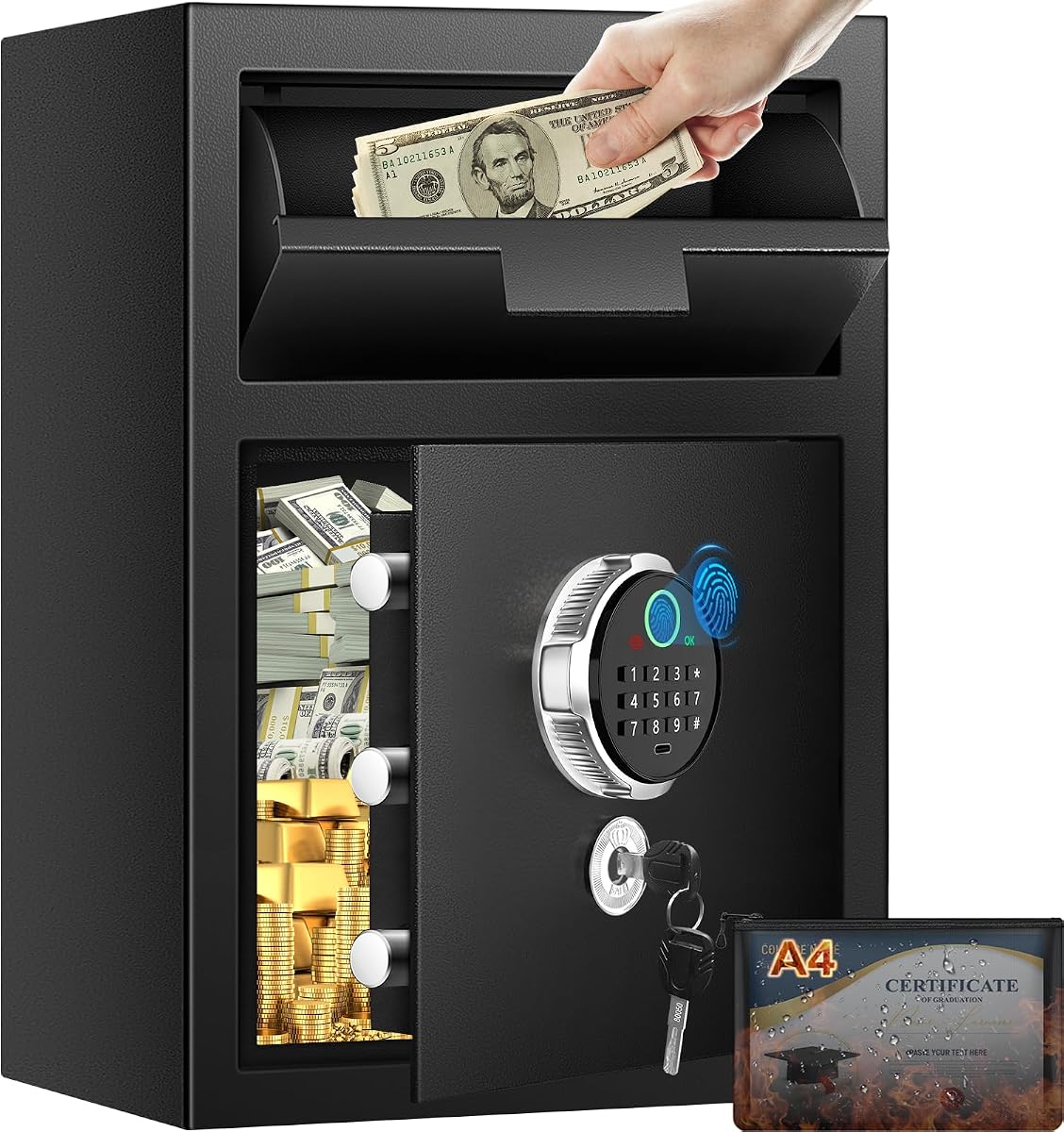
Key specs: 2.6 cu ft heavy-duty carbon-steel depository safe; front deposit slot with a saw-tooth anti-fishing baffle so cash goes in without opening the door; fingerprint, digital keypad, and 2 emergency keys; 3 solid steel bolts; audible alarm after repeated failed entries; floor-mounting bolts included; 31 lbs
This is the honest answer to “what if the cash isn’t a household reserve, it’s a business float or till money that gets added to all day.” A front deposit slot lets you drop cash in without opening the safe’s door at all, and the slot itself has a saw-tooth baffle specifically designed to stop someone fishing a wire or a coated stick back out through the opening — the same anti-fishing principle used on bank night-deposit boxes. Heavier carbon-steel construction and three solid steel bolts push this toward the burglary-resistance end of the spectrum that SafeWise’s buying guide ties to weight and gauge, not to fire rating. This is the pick that actually matches the brief’s second differentiator: for money you handle all day, the thing that matters is steel and anchoring, not how many minutes it survives a fire.
✅ Pros
- Deposit slot means the safe is opened far less often — fewer chances for the door to be left open or the code to be observed
- Anti-fishing baffle on the slot is a real, specific anti-theft design, not a generic marketing claim
- Heavier steel and three-bolt construction is the closest thing in this lineup to a genuine burglary-resistance upgrade over a standard personal safe
- Floor-mounting bolts are included, and at 31 lbs this is meaningfully harder to simply carry off than the two picks above
❌ Cons
- A real limitation worth stating plainly: this is a consumer depository safe, not a UL-rated burglary safe (TL-15 or TL-30) — those exist for commercial cash rooms, cost dramatically more, and are a different product tier than anything in this guide
- A noticeably thinner review base than the two picks above means less of a track record; one verified buyer reported a keypad and fingerprint glitch, which is worth knowing going in
- Not fire-rated
- At 2.6 cu ft and floor-mount oriented, this is the wrong shape for a nightstand or closet shelf
SentrySafe Fireproof and Waterproof Lock Box with Key Lock (FHW40100) — the true emergency-reserve pick
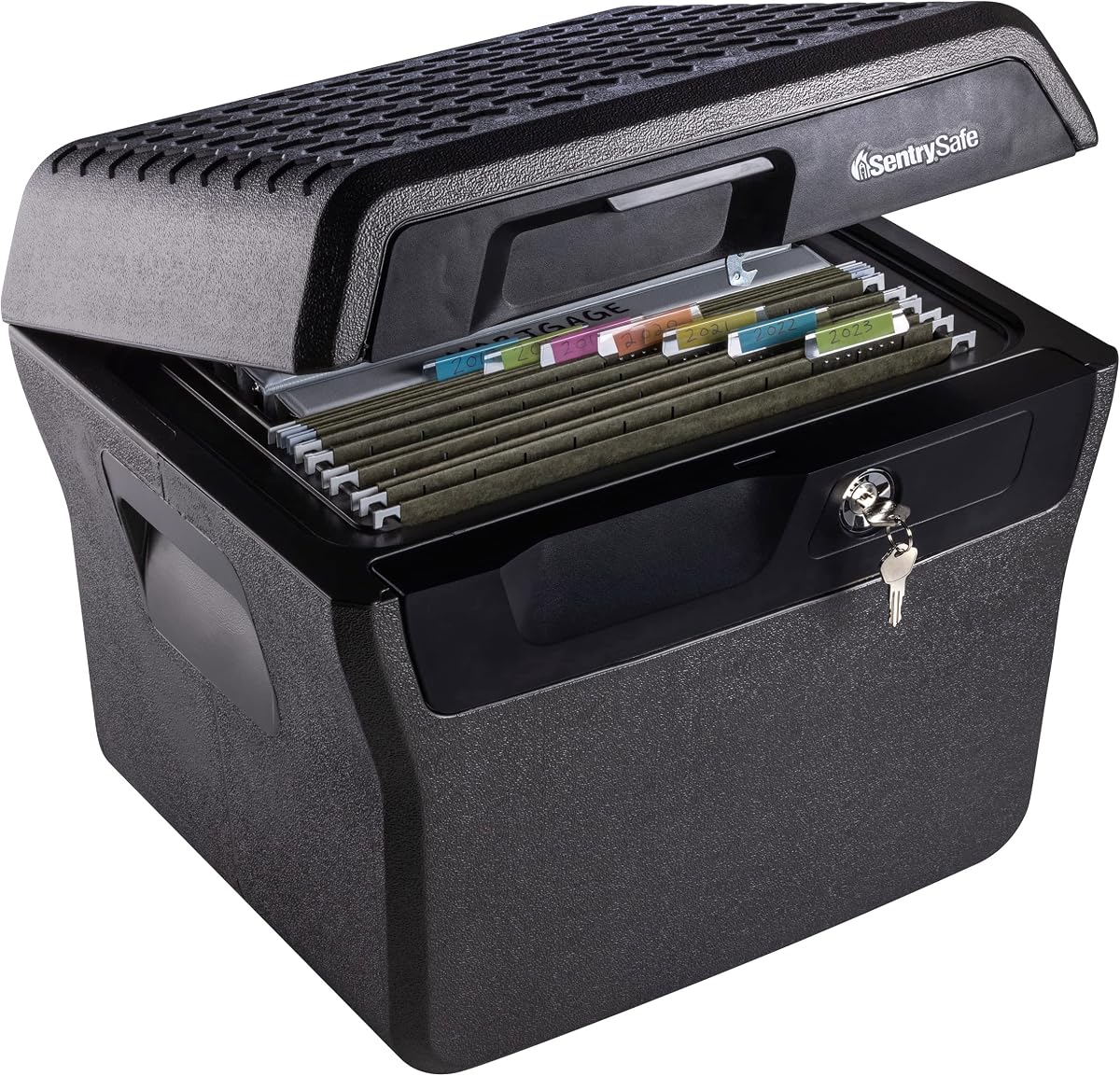
Key specs: 0.66 cu ft; UL Classified to withstand 1550°F for 30 minutes; ETL Verified for 72 hours of water submersion; key lock only, no keypad or biometric option; built-in carrying handles; 41 lbs
Every pick above optimizes for speed. This one deliberately doesn’t, and that’s the point. If the cash you’re protecting is a true emergency reserve — money you hope to never touch, kept specifically in case a fire, flood, or other disaster makes your bank inaccessible for a few days — then the safe’s job flips: it needs to survive the disaster, not be fast to open during a normal week. SentrySafe’s own product page states this model is UL Classified to withstand 1550°F for 30 minutes and ETL Verified for 72 hours of water submersion, both real third-party certifications rather than a manufacturer’s own marketing claim, and it carries Amazon’s Choice in its category. The tradeoff is the lock itself: key only, no keypad, no biometric. That is a genuinely slower, more deliberate form of access, and for this specific use case, that’s a feature, not an oversight.
✅ Pros
- UL Classified fire rating (1550°F, 30 minutes) and ETL Verified water rating (72 hours) are independently tested certifications, not self-reported specs
- 41 lbs and dense fire-insulation construction make it the heaviest, hardest-to-carry-off safe in this lineup
- Amazon’s Choice in its category, for whatever that signal is worth alongside the actual certifications
- Built-in carrying handles mean it can still be grabbed and taken with you if you do need to evacuate
❌ Cons
- Key lock only — genuinely the slowest of the four picks here, and a lost key with no backup plan is a real problem this design doesn’t solve for you
- No dedicated theft-deterrence hardware (no bolt-down anchor kit is emphasized the way it is on the picks above) — this is a fire-and-water safe first, not a burglary safe
- At 0.66 cu ft and 41 lbs, this is not a safe you want to open more than occasionally; treat it as a reserve, not a daily-use cash drawer
- If your key and its backup are both lost, our SentrySafe lost key replacement guide covers what that recovery process actually looks like
Combination Dial vs. Keypad vs. Biometric, for Cash Specifically
Most safe-buying advice treats lock type as a matter of taste. For cash you actually use, it isn’t. SafeWise’s own comparison of the three mechanisms lines up almost exactly with how often you’ll realistically open the safe: a combination dial requires turning to a passcode manually and is the slowest of the three; an electronic keypad gives quick PIN entry with battery backup; and a biometric fingerprint reader is the fastest, hands-free option of the group.
| Combination Dial | Electronic Keypad | Biometric (Fingerprint) |
|---|
| Typical open time | Slowest — manual dial-in | A few seconds | Under 1 second, hands-free |
| Best fit here | A rarely-opened emergency reserve | Daily household cash, one shared code | Cash several people access, or you personally open often |
| Failure mode | No batteries to die, but easy to fumble under pressure | Dead battery — needs an override key | Dead battery or sensor issue — needs an override key |
| Who can access it | Anyone who knows the combination | Anyone who knows the code (easy to share, easy to over-share) | Only enrolled fingerprints, unless the backup keypad or key is used |
| Not covered in this guide | None of the four picks above use a pure dial | — | — |
None of the four picks in this guide use a bare combination dial as the primary lock, and that’s deliberate: for cash specifically, the access-speed argument almost always wins over the marginal durability argument for a mechanical dial. If you’re weighing a dial-locked safe against these options for a different kind of valuable — documents, firearms, or jewelry, where you open the safe rarely — the tradeoffs shift, and our home safes decision-tree guide covers that broader set of use cases.
Bolt It Down, or It’s Just a Heavy Box
Fire rating gets most of the marketing attention on a safe’s box. Anchoring gets almost none, and for a cash safe it matters more. SafeWise’s buying guide is direct about this: heavy safes are harder for an intruder to remove and carry out quietly, and are generally more durable, but “it’s always worth going the extra mile” and bolting the safe to the floor or securely into a wall regardless of how heavy it already is. A 20-pound biometric safe with a great fingerprint reader is not meaningfully more secure than an unlocked drawer if a burglar can simply pick the entire box up and open it later, somewhere private, at their own pace.
Steel gauge works the same way as a secondary signal: a thicker door and body resist prying and cutting tools longer, which buys time — the actual thing a residential safe is selling, since none of the four picks here carry a certified TL-rated burglary classification the way a commercial vault does. All four ship with pre-drilled mounting holes and hardware in the box specifically so this step isn’t an afterthought or a separate purchase. Skipping it is the single most common way a genuinely well-built safe still gets stolen whole.
Anchoring solves theft of the safe itself. It does nothing about a second, quieter risk: whether your home’s overall security posture makes a burglar’s first ten minutes inside your house easy or hard. Layered protection — a monitored door or window sensor on the room the safe lives in, for instance — changes the odds before anyone gets close enough to try prying at a bolted-down box. Our guide to wireless door and window sensors covers that layer specifically, and if you’re building out a fuller system rather than a single room, our DIY home alarm systems guide is the place to start.
How Much Cash Actually Belongs in the Safe
This is the practical question the insurance section above is really pointing at: a safe protects whatever cash is inside it from theft, fire, and water, but the insurance sublimit means only a small slice of a real loss is likely to come back to you through a claim. That should shape how much cash you actually keep on hand, not just which safe you buy.
A Rough Way to Think About It
✅ Cash that reasonably belongs in a home safe
- A short emergency reserve meant to bridge a few days if banks or ATMs are briefly unreachable
- A small household cash fund for reimbursing sitters, contractors, or day-to-day errands
- A business’s daily float or till money, especially in the drop-safe pick above, between bank runs
- Cash you’d genuinely be fine never getting insurance reimbursement for beyond a couple hundred dollars
❌ Cash that belongs in a bank instead
- Savings meant to grow — a safe pays no interest and carries real fire/flood/theft risk a bank account doesn’t
- Any amount large enough that losing it would be a genuine financial setback, given the sublimit covers only a small fraction of it
- Business revenue beyond a working float — that belongs in a bank deposit, not accumulating in a drop safe
- Anything you’d want appraised and insured at full value — that mechanism exists for jewelry and collectibles, not for currency
None of this is a reason to skip the safe. It’s a reason to be deliberate about what goes in it. A safe is the right tool for a working amount of cash you need fast, physical access to. It is the wrong tool for money you’re trying to protect the way a bank protects deposits — that protection comes with FDIC insurance backing it, which no home safe, however well built, can replicate.
Final Recommendation
Start with how often you’ll open it, not with steel gauge. If this is a household reserve you’ll touch occasionally and want to keep simple, the Amazon Basics Steel Security Safe with Electronic Keypad is the right starting pick — it’s the cheapest way to get a genuinely anchor-able, quick-access safe, and anchoring is the single feature SafeWise’s own research treats as most important.
If several people in the household need fast, individual access, or you personally open it daily, step up to the Grimtron 20LB Biometric Safe with Fingerprint Lock for the fingerprint speed. If the cash is genuinely business float or till money that gets handled all day, the Tepafac 2.6 Cuft Biometric Drop Safe for Business is the one built for that specific job, deposit slot and all. And if what you’re actually protecting is a rarely-touched emergency reserve you want to survive a real disaster, the SentrySafe Fireproof and Waterproof Lock Box with Key Lock (FHW40100) is the honest pick, slower key lock and all.
What would change this recommendation: if you’re insuring anything beyond a working cash amount — savings, a large sum, anything you’d be genuinely hurt to lose — the right fix isn’t a bigger safe, it’s a bank account. No safe in this guide, or any price tier above it, changes the 200-dollar sublimit sitting in your homeowners policy. Call your insurer and ask about your specific policy’s special limits of liability before you decide how much cash to actually keep at home.
SafeBode does not yet run an in-house product testing program. This guide is built from manufacturer specifications, official support documentation, current retail listings and verified buyer feedback rather than hands-on testing, and we say so plainly rather than implying testing we have not done.
Frequently Asked Questions
How much cash is actually safe to keep in a home safe?
There’s no fixed number, but it’s worth sizing it to what you’d be comfortable never seeing insurance reimbursement for beyond a small standard sublimit. A working reserve or float fits that description; meaningful savings generally don’t, since a bank account carries deposit insurance a home safe cannot replicate.
Does homeowners insurance cover cash stolen from a safe?
Only up to a standard sublimit — commonly around 200 dollars for money, coins, and medals under a typical policy’s personal property section, regardless of how secure the safe holding it was. Check your specific policy, since insurers vary.
Is a biometric lock more secure than a keypad for a cash safe?
It’s faster, not necessarily more secure. A keypad code can be shared or observed; a fingerprint generally can’t, but both rely on the same steel body and anchoring for actual theft resistance. Pick based on how many people need access and how quickly.
Do I need a fireproof safe if I’m mainly protecting cash from theft, not fire?
Not necessarily. A theft-focused safe with a fast keypad or biometric lock and solid anchoring is the better fit for cash you access often. Reserve a fire-rated safe for a true emergency stash you rarely open.
Should a cash safe be anchored even if it’s already heavy?
Yes. A heavy safe is harder to remove, but not impossible, and anchoring converts “harder” into “a burglar has to bring tools and time they usually don’t want to spend.” All four safes in this guide ship with mounting hardware for exactly this reason.
What’s the difference between a drop safe and a regular safe for cash?
A drop safe adds a deposit slot so cash can go in without opening the main door, which means the safe is unlocked far less often. It’s built for a till or float that gets added to throughout the day, not for a reserve you rarely touch.
Can I increase my homeowners insurance coverage for cash?
Scheduled personal property riders exist for individually appraisable valuables like jewelry or fine art, but that mechanism doesn’t map cleanly onto currency, which has no serial number or appraisal to attach to a rider. Ask your insurer directly what, if anything, they offer for cash specifically.
How many people should know the code or have fingerprint access?
As few as actually need it. Every additional person with access is another way the code gets written down, shared, or observed. A biometric safe with individually enrolled fingerprints narrows this more precisely than a single shared keypad code.
Is an inexpensive keypad safe actually secure, or just a deterrent?
Mostly a deterrent against casual opportunists and household access, not a match for a determined, tooled-up burglar. That’s true of nearly every safe at this size and price point, which is exactly why anchoring it matters as much as the lock itself.
Sources
Show sources (6)
- [1] Policygenius — “Personal Property Insurance (Coverage C) for Homeowners,” policygenius.com/homeowners-insurance/personal-property-insurance/
- [2] SafeWise — “5 Things Your Home Insurance Might Not Be Covering,” safewise.com/blog/what-is-not-covered-by-home-insurance/
- [3] Insurance Information Institute (III) — “Insurance for Your House and Personal Possessions,” iii.org/article/insurance-for-your-house-and-personal-possessions
- [4] NerdWallet — “Personal Property Insurance for Homeowners and Renters,” nerdwallet.com/insurance/homeowners/learn/personal-property-insurance
- [5] SafeWise — “Best Home Safes 2025,” safewise.com/resources/home-safe-buyers-guide/
- [6] SentrySafe — “Fire/Water File, FHW40100,” sentrysafe.com/product/FHW40100


